Diversification Helped India Offset Export Slowdown to the US: SBI Research
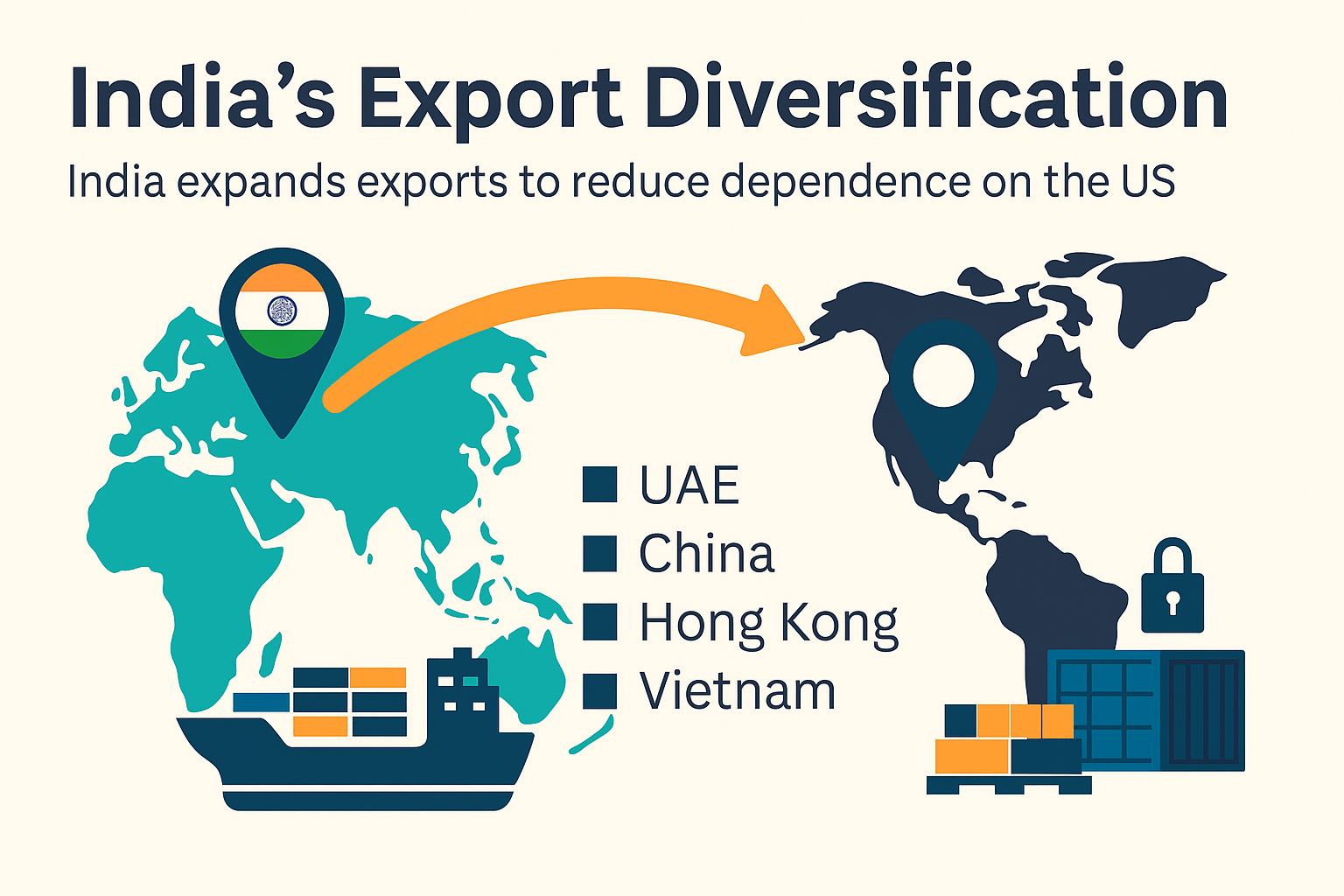
India’s broader export footprint strengthens resilience amid shifting global demand patterns
India’s export performance continues to display stability and resilience, even as shipments to the United States—its largest single-country export destination—have softened since July 2025. According to a detailed assessment by SBI’s Economic Research Department, India has successfully compensated for this decline through diversified export markets, reducing dependence on the US and improving overall export sustainability.
India’s Export Basket Is Getting More Diversified
SBI economists observed that while the share of the US in India’s merchandise exports has been declining, the share of several other countries has increased significantly. This diversification has enabled India to maintain export momentum even during periods of subdued demand from major Western economies.
Countries that gained share in India’s export mix:
- UAE – rose to 9.8% (from 8.4%)
- China – rose to 4% (from 3.3%)
- Hong Kong – rose to 3.1% (from 1.4%)
- Vietnam, Japan, Bangladesh, Sri Lanka, Nigeria – all recorded positive momentum across product categories
The report also hints at an interesting possibility: some of these countries may be importing Indian goods and then re-exporting them to the US, suggesting integrated global supply chains and India’s rising role as a production hub.
Export Trend: Overall Growth Remains Positive
Despite the slowdown in the US, India’s total merchandise exports for the first half of FY26 grew 2.9%, reaching $220 billion compared to $214 billion in the same period last year.
Surprisingly, cumulative exports to the US for the same period actually showed 13% growth, rising from $40 billion to $45 billion. Part of this growth may be attributed to front-loaded shipments ahead of US tariff adjustments.
This indicates that while month-on-month flows softened in late 2025, underlying demand for Indian goods in the US remains intact.
Why India Is Able to Withstand US Slowdown
The SBI Research report highlights several structural factors contributing to India’s resilient export performance:
✔ Competitive Tariff Structure
India enjoys one of the most favourable tariff environments among Asian exporting nations, enhancing its appeal as a supply-chain partner.
✔ Strengthening Manufacturing Capabilities
Sectors such as electronics, machinery, chemicals, apparel, and LPG equipment have expanded capacities and improved export readiness.
✔ Improved Global Trade Relationships
Ongoing trade discussions, including with the US, continue to boost investor and exporter confidence.
✔ China+1 & Friend-Shoring Trends
Global corporations diversifying away from China are increasingly sourcing from India, especially for mid-value manufacturing.
Finacare Insight: What This Means for Investors
India’s diversified export landscape has direct implications for equity investors:
1️⃣ Export-Oriented Sectors May Deliver Stronger Earnings
Look for opportunities in:
- Engineering goods
- Specialty chemicals
- Auto components
- Electronics manufacturing
- Textiles & garments
2️⃣ Firms with Multi-Country Export Presence Are Better Positioned
Companies relying heavily on US demand may face temporary headwinds, while those with broader global exposure are likely to outperform.
3️⃣ Logistics & Port-Linked Stocks Could Benefit
Rising export activity supports:
- Port operators
- Shipping firms
- Freight logistics
- Container & warehousing companies
Stable Export Flows May Support the Rupee
Diversification reduces dependence on US cycles, supporting current account stability and improving currency predictability.
Final Takeaway
India’s export story is undergoing a strategic transformation. By reducing reliance on any single market—especially the US—India is building a stronger, more resilient, and more globally integrated export ecosystem.
For investors, this diversification opens new opportunities across manufacturing, logistics, and export-led sectors. As global trade patterns shift, companies with multi-region exposure and strong supply-chain capabilities are likely to emerge as long-term winners.